About EBM Tools
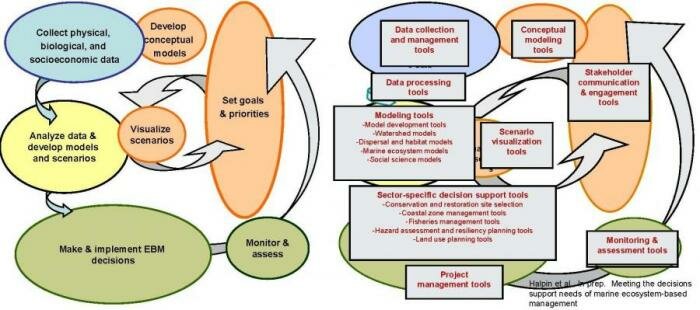
There are a wide variety of types of EBM tools. The schematic below (from Halpin et al., In prep) shows possible steps in an EBM process and the type of tools that could facilitate that step. Descriptions of the functionality of the types of tools is below. [You can download a copy of the schematic here.] [La Versión en Español]
DECISION SUPPORT TOOLS
These tools are designed to facilitate common decisions for specific sectors or processes. Types of Decision Support Tools in the EBM Tools Database include:
- Conservation and Restoration Site Selection Tools- These tools can identify and/or prioritize optimal sites for conservation and restoration using goals or criteria determined by the user. Additional Resources.
- Ocean Zoning and Coastal Zone Management Tools- These tools are designed specifically for coastal zone management issues and often incorporate data or simple models specific to coastal processes.
- Fisheries Management Tools- These tools help determine levels and types of fishing that are ecologically and/or economically sustainable. Additional Resources.
- Hazard Assessment and Resiliency Planning Tools- These tools can help communities assess vulnerability to natural and man-made hazards, determine ways to reduce vulnerability, and prepare for possible emergencies. Additional Resources.
- Land Use Planning Tools- Among other things, these tools can help determine what land uses are compatible with environmental goals (such as habitat or species protection, quality) and the impact of changes in land use on terrestrial and aquatic environments. Additional Resources.
MODELING AND ANALYSIS TOOLS
These tools are designed to conduct scientific analyses of a varierty of processes. There are also numerous models that have been developed for specific regions, species, or ecosystems that are not included in database. These tools could be extremely useful for EBM projects. The best way to find out about these tools is to consult researchers at local universities or organizations. Types of Modeling and Analysis Tools in the EBM Tools Database include:
- Model Development Tools- These tools help develop models of ecological or socioeconomic processes.
- Geographic Information Systems- Geographic information systems (GISs) can integrate, store, edit, analyze, manage, share, and display geographic information. GIS applications allow users to create searches, analyze spatial information, edit data, and create and edit maps.
- Watershed Models- These models simulate watershed processes and the influence of watershed changes (generally due to changes in land use) on freshwater and coastal ecosystems. Additional Resources.
- Estuarine and Marine Ecosystem Models- These models simulate interactions between species and benthic and pelagic habitat in estuarine and marine environments. Additional Resources.
- Oceanographic and Dispersal Models- These models simulate current flows and/or the dispersal of organisms and pollutants in the marine environment.
- Habitat Suitability and Species Distribution Models- These models estimate the habitat requirements or suitability of a given habitat for a species.
- Socioeconomic Models- These models simulate economic and social processes, often in response to potential management actions. Additional Resources.
DATA COLLECTION, PROCESSING, AND MANAGEMENT TOOLS
These tools help collect, process, and manage geophysical, biological, and socioeconomic data.
STAKEHOLDER ENGAGEMENT AND OUTREACH TOOLS
These tools help engage stakeholders in decision making processes; facilitate communication between managers, scientists, and stakeholders; and educate stakeholders about ecological or management processes. Additional Resources.
CONCEPTUAL MODELING TOOLS
These tools help develop conceptual models of the ecosystem, human interaction with natural ecosystems, and/or management processes.
VISUALIZATION TOOLS
These tools help scientists, managers, and stakeholders visualize the current state of resources and potential future states resulting from different management actions. Many of the other types of tools include visualization capabilities.
PROJECT MANAGEMENT TOOLS
These tools help manage projects including budgeting, scheduling, and reporting.
MONITORING AND ASSESSMENT TOOLS
These tools help with monitoring and assessment functions such as selection sample sites.
Search for tools in the EBM Tools Database.
Tools that are NOT in the EBM Tools Database
There are thousands of tools out there. We have tried to limit the database to the ones that will be most useful for implementing EBM in coastal and marine environments. Some tools that we left out of the database are:
- Tools that are not actively maintained or supported.
- Tools that deal solely with terrestrial environments with no consideration of influences on coastal or marine environments.
- Tools that only model water flows or lower trophic levels, aspects of coastal and marine ecosystems which are not generally actively managed. Exceptions include coastal erosion, oil spill, and larval transport models designed to be used by managers.
- Tools that are highly specialized for particular regions, species, ecosystem, or project unless the concept appears to have widespread applicability for other projects.
- Fisheries stock assessment models that do not deal with species' interactions.
- Tools that are primarily databases or non-analytical mapping tools for specific projects unless the concept appears to have widespread applicability for other projects.


